Colombia: From Summit to Jungle to Sea
January 20 – February 4, 2024
Colombia is an evocative country full of surprises. The natural beauty, the flora and fauna, the mountains and the jungles and the seashores, the gracious people, and the excellent cuisine combine to make this one of the most attractive and lightly visited destinations very close to home.
There are 500 species of mammals in Colombia, and 1,700 species of birds, more than any other country, almost 20% of all birds on earth. Accompanying us throughout was my old friend Rodrigo Arias, a famous Colombian mountain guide with a deep love and understanding of his country.
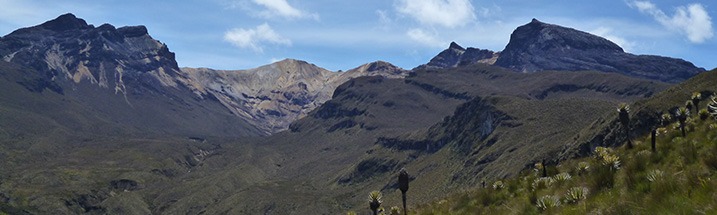
This was a wide-ranging journey into the heart of this re-emerging nation. We toured Bogota, the capital, with its fascinating museums and mountaintop viewpoints. Overnighting both in isolated farms and in tents, we trekked 9 days through the remote Paramo landscape whose flora and fauna is unique to this region. We climbed two tall Andean mountains that gave views over other active volcanoes nearby. We explored the Guaviare, an Amazonian region little-known until a recent National Geographic article drew attention to it, newly famous for the pre-Colombian artwork painted on the rock walls of local mountains. While in the rainforest we also witnessed endemic birds, mammals, and dolphins in their natural settings. All in all, this was a surprising and fascinating journey through a country still emerging to the outside world.
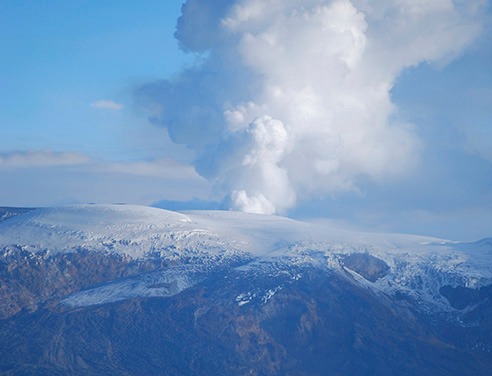
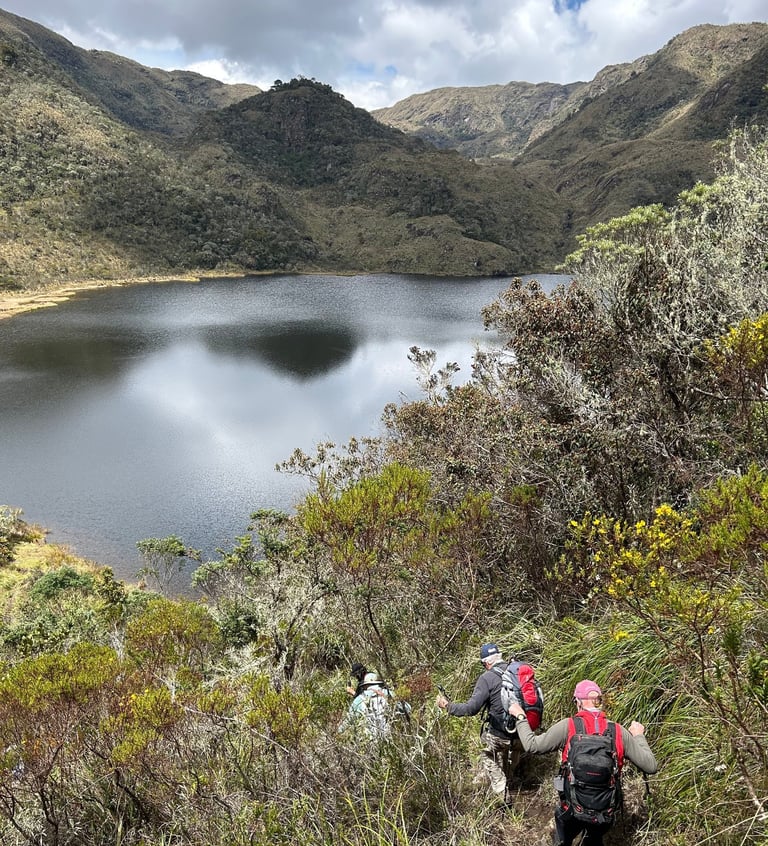
January 23 — A 40-minute drive brought us to La Punta at 10,000', where our trek began. With pack animals carrying our gear, a 4-hour hike across the Paramo, the fascinating alpine ecosystem unique to Colombia, delivered us to Finca Vancouver at 11,500' for the night in basic but clean farm rooms.
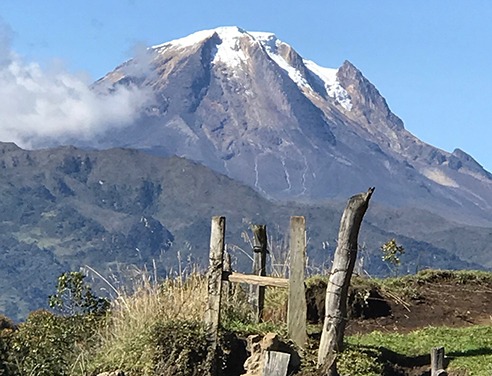
January 24 — Five hours of hiking across the rolling Paramo terrain revealed its unusual plants and endemic birds. Camp that night was in tents on grass at the foot of impressive Volcan Tolima, next to the hot springs at Termales de Canon at 13,000'. A dip in the expansive hot pool helped soothe our aching muscles. Andean condors nested in the crags overhead.
January 25 — The day's hike took us up to Volcan Tolima Base Camp, leaving vegetation behind as the sandy rocky trail wound through volcanic outcrops. Tents that night were pitched at the foot of the climb at 14,800'.
January 26 — Starting pre-dawn, we slowly climbed the sandy trail toward the walls of majestic Volcan Tolima, beginning with a circuitous route among rocky steps where we roped up. The climbing was not difficult, but the rope kept everyone safe. At about 16,500' we stepped onto the nearly crevasse-free glacier and, still roped up, climbed to the summit at 17,150'. After celebrating, we retraced our route to camp before descending to Valle de Placer at 12,000' to camp in pleasure.
January 27 — A relaxed start in this lovely setting, followed by a three-hour walk over up-and-down terrain past bubbling creeks and grassy hillsides, took us to Finca el Aguila at 12,200'. That night we slept in basic but comfortable beds at the farm, dining on local cuisine cooked at the unique Colombian hearth.
January 28 — A stiff 6-hour walk climbed out of the valley to the alpine region at the base of Volcan Santa Isabel, an exciting hike traversing beneath the mountain with many scenic viewpoints along the way. Camp that night was among the tarns and streams fed by Santa Isabel's glaciers and snowfields, our acclimatization enhanced by these days at higher altitudes.
January 29 — Another pre-dawn start as we headed out for Santa Isabel's summit. There is no trail because few people climb this mountain, adding to the appeal. The non-technical ascent wound among rock outcrops, on grass and scree, leading to a dramatic 16,236' summit few others have achieved, with views for hundreds of miles in all directions. Following another celebration, we continued off-trail down the other side to Laguna del Otun at 12,800' for camp.
January 30 — Four hours on a good trail across the Paramo, with its unusual flora and fauna, brought us down to the park entrance at Potosi, followed by a four-hour drive out of the mountains to the colorful town of Salento, where we checked into our hotel. Salento's classic wooden architecture sits in the warm fresh air of the Colombian coffee region, with coffee farms filling the landscape. Dinner at a fine restaurant.
January 31 — Flights back to Bogota, then on to San Jose' de Guaviare' in the steamy lowlands, where a stroll through the nearby forest with local naturalist Marcel turned up endemic birds. Dinner at the Amazonian Restaurant, staying overnight at the finest hotel in town.
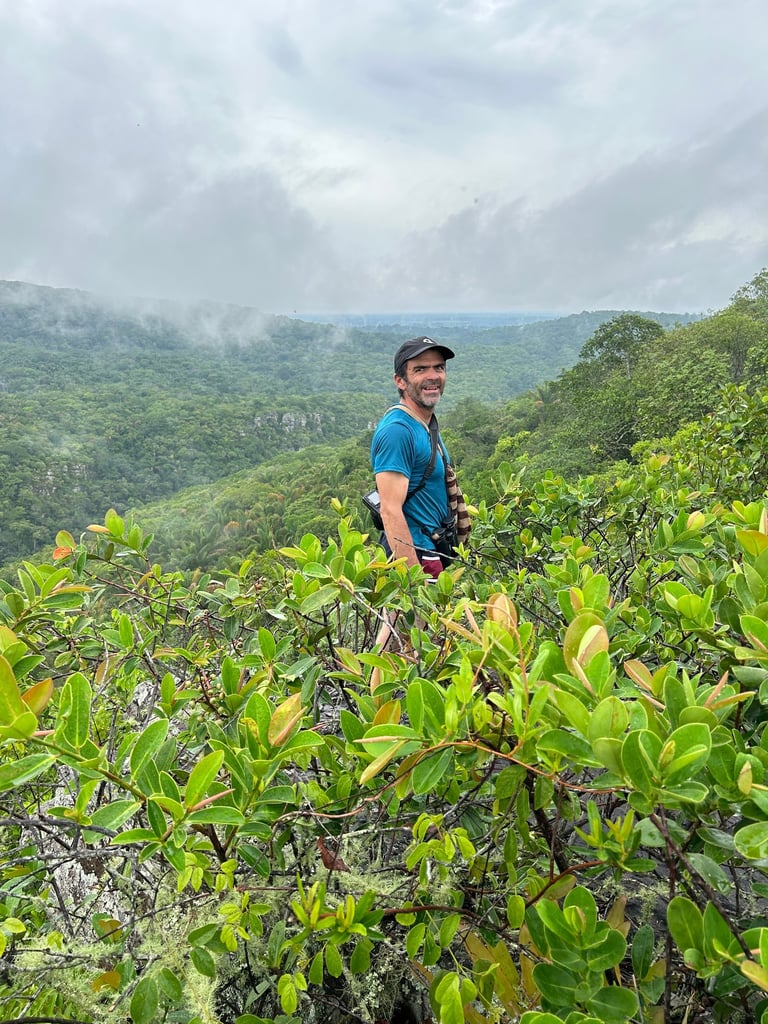
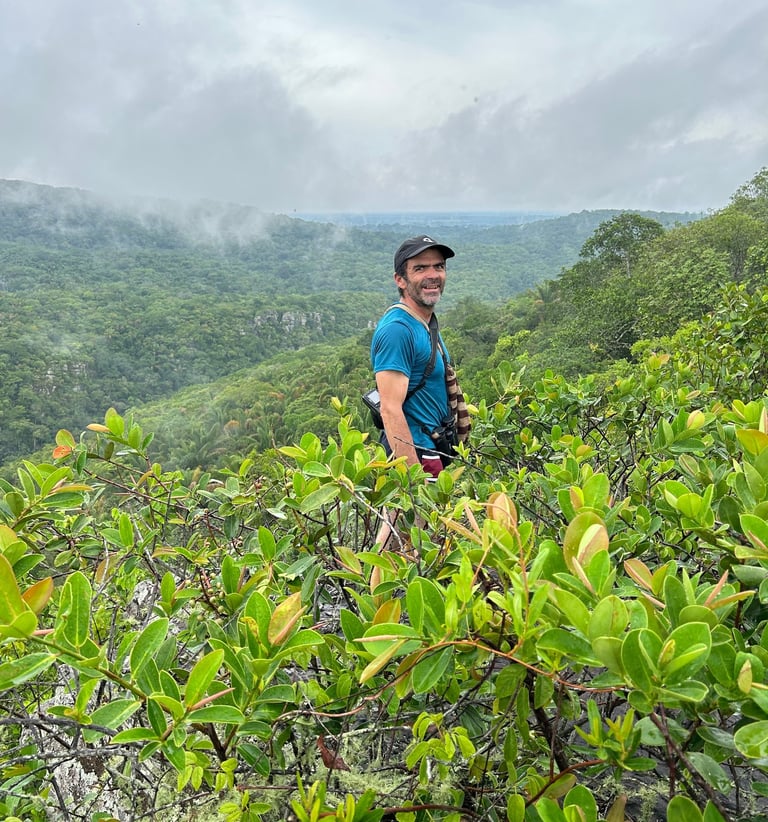
The Guaviare is a region little known and little visited by outsiders. It occupies the divide between the Amazon and the Oronoco Rivers in the vast south-eastern lowlands, making it geographically important in historic and pre-historic times. The native old-growth tropical forest is rich in habitat for unique flora and fauna, which we explored in detail by riverboat, road and on foot. Thousands of ancient pictographs were recently discovered in caves and on rock walls in this region, featuring fish, mammals, plants, people and rivers, and we hiked up to several of them to ponder the past. The artists are still largely uncertain, lost in the fog of time and remoteness, although it's thought that the indigenous Nukak Maku tribe living in the area now are the descendants of the original artists.
February 1 — Traveling light, we walked to the boat dock and boarded a giant motorized canoe made from a single tree. An hour upstream brought us to the indigenous village of Raudal, where we spent the night in basic but clean and comfortable bungalows. That afternoon a fifteen-minute motor upstream followed by a twenty-minute hike led us to a nearby tepui (table-top mountain) and pictographs painted up to twelve thousand years ago.
February 2 — A short drive followed by a two-hour hike brought us to Cerro Azul and thousands of pictographs said to be thousands of years old. Few people and almost no foreigners have come here. With a local expert speaking her indigenous language, through a translator we learned the significance of this evocative place before returning to San Jose' de Guaviare for dinner and overnight.
February 3 — Flights back to Bogota to prepare for our evening departures home.
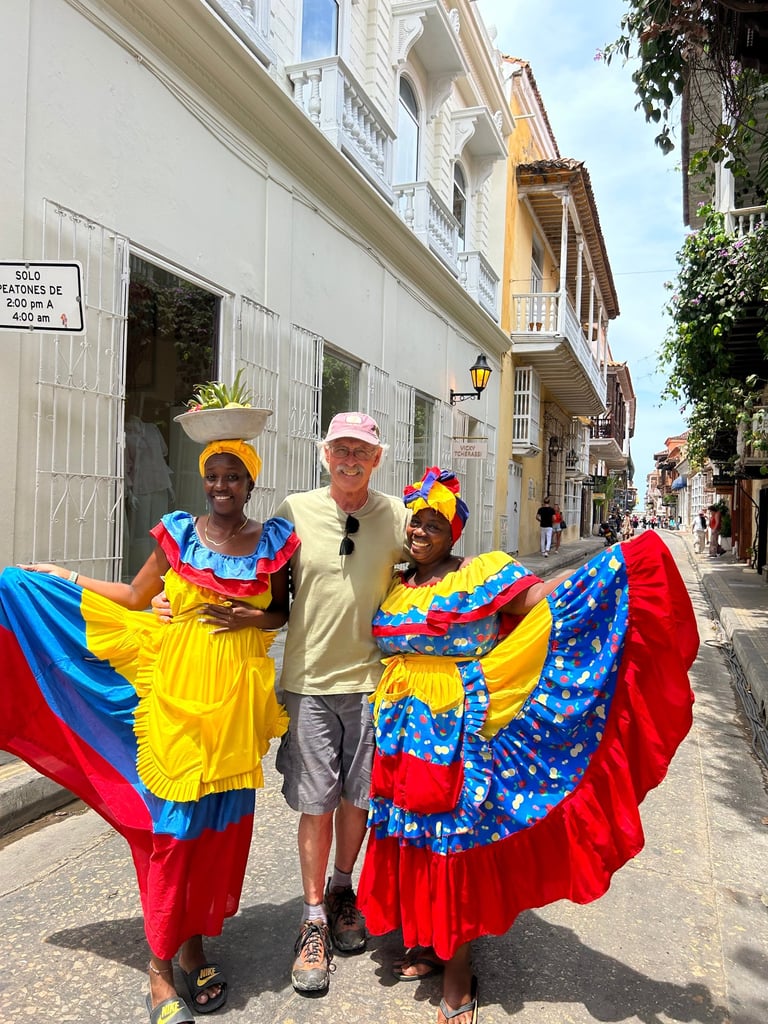
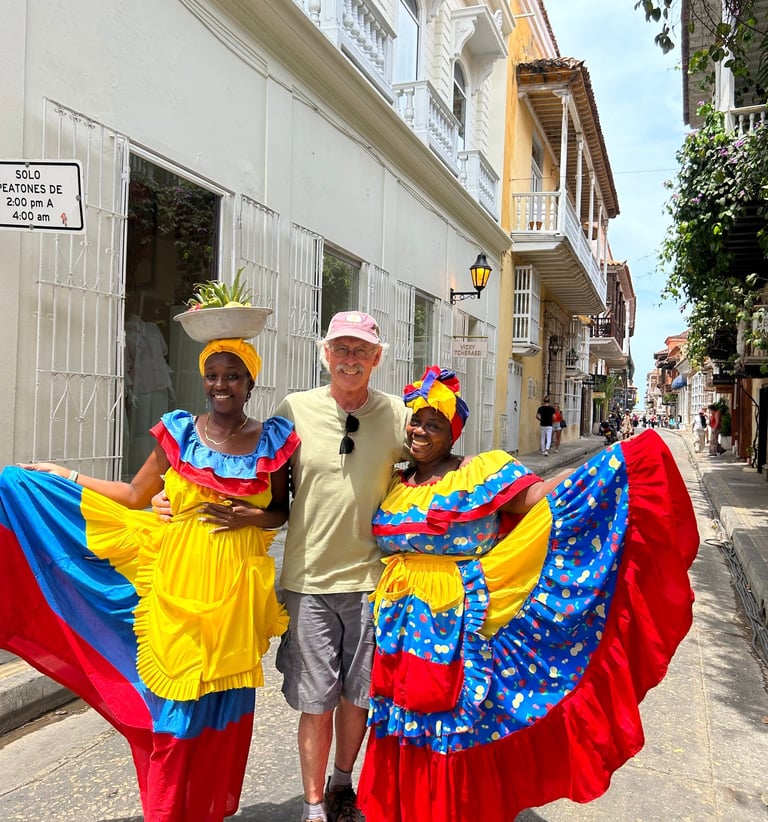
Those who wished flew on to Cartagena to explore that historic city on the Caribbean. A beautiful and well-preserved colonial city and World Heritage Site, Cartagena was Spain's primary port during the early years of the Conquest. We checked into our hotel in the middle of the Old Town and spent the evening on the town.
February 4 — A full day exploring the sights and sounds of Old Town Cartagena — wandering narrow streets, visiting Las Murallas (the thick defensive walls constructed over two centuries by the Spanish), marveling at the well-preserved colonial architecture, and sampling street food and street music, museums and monasteries and mansions, palaces, plazas, and cathedrals.
February 5 — Morning flights returned us safely home to the USA.
Colombia Itinerary and Accommodations
January 20 — We arrived in Bogota, Colombia's capital. We met at the airport and transferred to our hotel in the city's cultural epicenter, La Candelaria. Dinner on your own at the hotel.
January 21 — Bogota is an engaging and vibrant capital cradled by chilly Andean peaks and steeped in sophisticated urban cool. Well-preserved colonial buildings house museums, hotels, restaurants, and bars, peppered among 300-year-old houses and churches. We visited the Gold Museum, stuffed with priceless items dating to the time of the Incas. We visited the Museo Botero, the famous homage to all things chubby and humorous. We summited 10,330' Cerro de Monserrate aboard the cable car for views out over the Andes and across the Bogota Valley.
January 22 — With an early start we drove six hours out of the valley to the west, over high passes, and into the heart of the Parque Nacional Los Nevados, a range of volcanos in the Central Andes. We traversed forest and plain, and ultimately climbed into the mountains. Overnight and dinner in Palomar at a comfortable mountain lodge at 8000'.